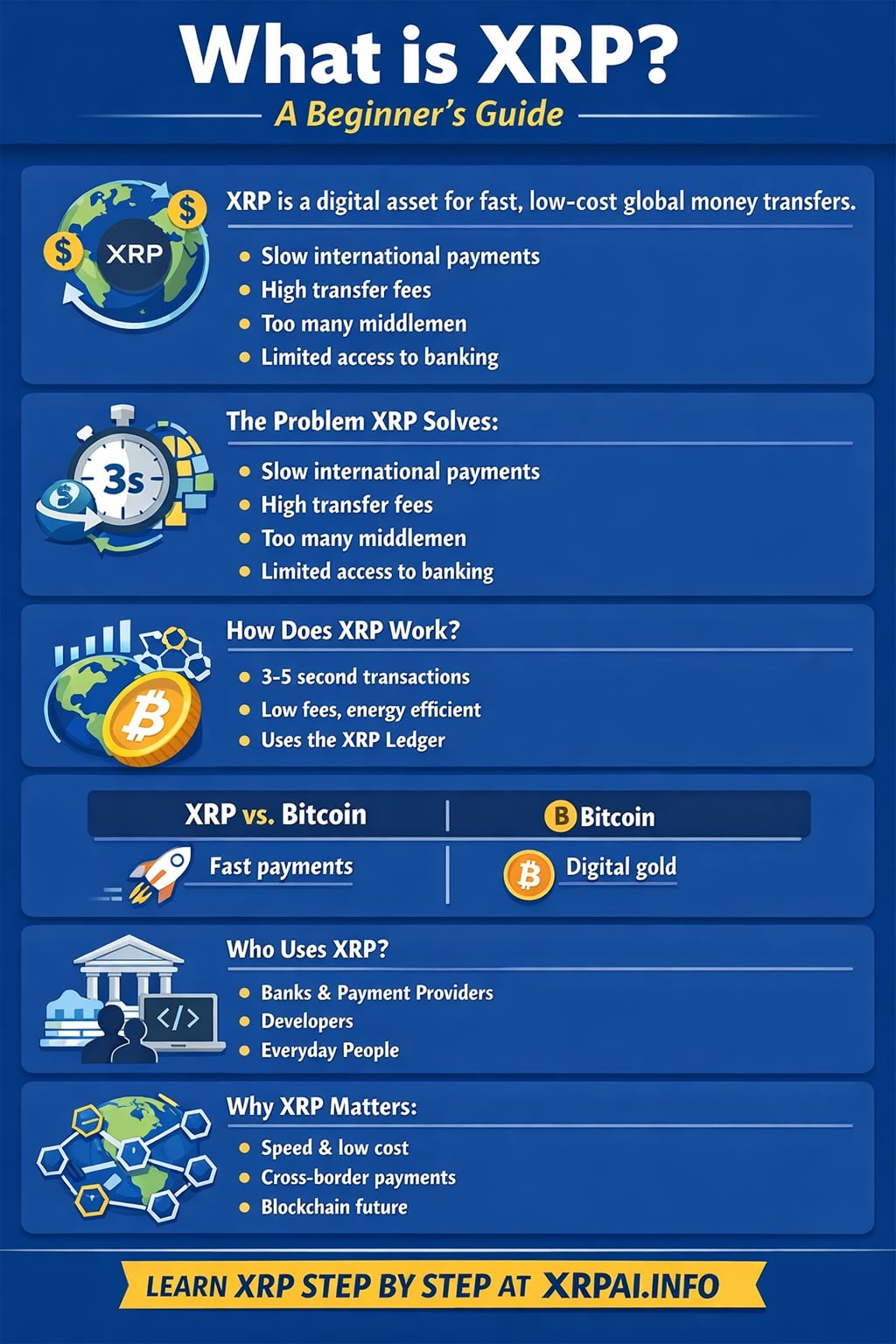
XRP is a digital asset designed to move money quickly, cheaply, and efficiently across borders.
Unlike traditional banking systems that can take days to settle payments, XRP was created to help move value in seconds—anywhere in the world.
This guide explains what XRP is, why it exists, and why it matters, in simple language anyone can understand.
What Is XRP?
XRP is a digital currency that runs on the XRP Ledger, a decentralized blockchain designed for speed and efficiency.
At its core, XRP was built to solve one major problem:
Global money transfers are slow, expensive, and outdated.
XRP allows value to be transferred almost instantly, with very low fees, without relying on traditional banks or payment intermediaries.
What Problem Does XRP Solve?
Today’s financial system still relies on infrastructure built decades ago.
- International transfers taking 3–5 business days
- High fees for cross-border payments
- Multiple middlemen slowing transactions
- Limited access for billions of people worldwide
XRP was designed to help modernize this system by acting as a bridge asset between different currencies.
How Does XRP Work?
XRP operates on the XRP Ledger (XRPL), which is different from many other blockchains.
- Transactions settle in 3–5 seconds
- Fees cost fractions of a cent
- No mining required
- Energy-efficient by design
Instead of miners, the XRP Ledger uses a consensus mechanism where independent validators agree on transactions. This allows the network to stay fast, secure, and scalable.
Is XRP the Same as Bitcoin?
No. XRP and Bitcoin were designed for very different purposes.
- Bitcoin was designed as digital gold and a store of value
- XRP was designed for fast payments and liquidity
Bitcoin can take minutes or hours to settle. XRP settles in seconds.
Both are cryptocurrencies, but they serve different roles in the digital economy.
Who Uses XRP?
- Financial institutions
- Payment providers
- Developers building on the XRP Ledger
- Individuals sending and receiving value
Many institutions explore XRP because it can reduce costs and increase speed when moving money across borders.
Is XRP Centralized?
This is a common beginner question.
XRP itself is not controlled by a single entity. The XRP Ledger is open-source and maintained by a global network of independent validators.
While Ripple (a company) helped develop early XRP technology, the XRP Ledger continues to operate independently.
Understanding this distinction is important:
XRP is the digital asset
XRPL is the decentralized ledger
Ripple is a company building solutions that can use XRP
Why Does XRP Matter?
XRP matters because the world is moving toward digital payments, faster settlement, tokenized assets, and blockchain-based infrastructure.
As global finance modernizes, systems that are fast, scalable, and efficient become increasingly important. XRP was designed with this future in mind.
Is XRP Good for Beginners?
XRP is often considered beginner-friendly because transactions are fast and inexpensive, wallets are easy to use, and the technology focuses on real-world utility.
However, like all digital assets, learning how it works is more important than speculation.
Education comes first.
How Do You Learn XRP the Right Way?
Many beginners struggle because:
- Information online is fragmented
- Content focuses on hype instead of understanding
- Key basics are skipped
This is why platforms like XRPAI.info exist.
XRPAI teaches:
• What XRP is
• How the XRP Ledger works
• How to safely use wallets
• How XRP fits into the future digital economy
All explained step by step, without technical overwhelm.
Final Thoughts
XRP is not just another cryptocurrency. It is a digital asset designed to help modernize how value moves around the world.
Understanding XRP is not about getting rich quickly—it’s about understanding how money, technology, and the digital economy are evolving.
The future belongs to those who understand it.
Education first. Hype last.